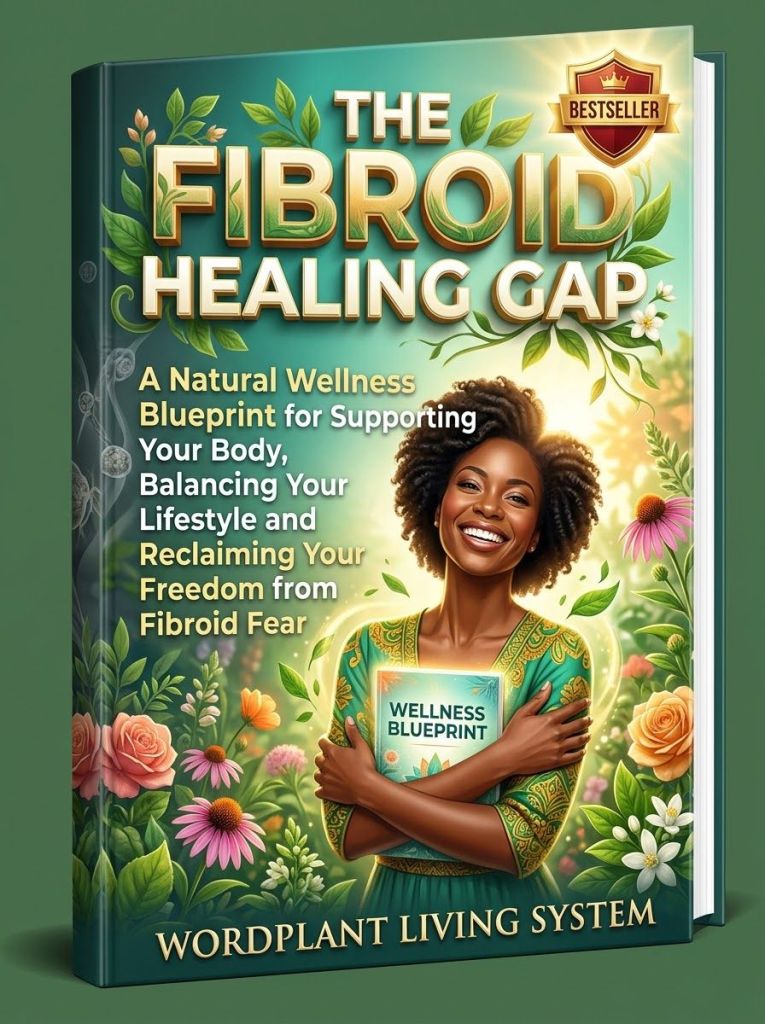
A Natural Wellness Blueprint for Supporting Your Body, Balancing Your Lifestyle and Reclaiming Your Freedom from Fibroid Fear
By Wordplant Living
Fibroids can change the way a woman experiences her body.
Heavy menstrual bleeding, pelvic discomfort, abdominal pressure, fatigue, painful periods, frequent urination and concerns about fertility can create physical and emotional stress. But beyond the symptoms themselves, many women also experience something less visible: fear and uncertainty about what their future holds.
What can I do naturally?
What should I eat?
Can lifestyle changes make a difference?
How do I support my body while working with my healthcare provider?
Where do I even begin?
These are some of the questions that inspired The Fibroid Healing Gap: A Natural Wellness Blueprint for Supporting Your Body, Balancing Your Lifestyle and Reclaiming Your Freedom from Fibroid Fear, by Wordplant Living.
The book introduces a different way of looking at wellness. Instead of focusing only on the condition, it encourages you to examine the gap between where your health is today and where you want it to be.
The goal is not to promise a miracle cure. It is to give you a framework for making better-informed lifestyle and wellness decisions while encouraging appropriate medical evaluation and care.
Here are 10 vital lessons and takeaways from the book.
1. Your Symptoms Are Messages Worth Listening To
One of the foundational ideas in the Healing Gap approach is:
Symptoms are messages, not enemies.
Symptoms such as heavy periods, pelvic pressure, fatigue or pain should not simply be ignored or covered up without understanding what may be contributing to them.
Your body is communicating with you.
Instead of asking only, “How can I make this symptom disappear?”, the Healing Gap approach encourages another question:
“What is my body trying to tell me, and what can I learn from it?”
This does not mean assuming every symptom has a natural explanation or that medical care is unnecessary.
It means becoming a more informed participant in your health journey.
The first step toward changing your wellness direction is awareness.
2. There Is a Gap Between Your Current Health and Your Desired Health
The central concept of the book is the Healing Gap.
Imagine two points.
On one side is your Current State—what you are experiencing today.
On the other side is your Desired State—the level of wellness, confidence, energy and freedom you want to experience.
Between the two lies the gap.
That gap may contain:
- Nutrition challenges
- Sedentary living
- Poor sleep
- Chronic stress
- Digestive problems
- Environmental factors
- Emotional burdens
- Limited health knowledge
- Inconsistent self-care
- Fear and uncertainty
The important lesson is that you do not have to cross the entire gap in one day.
You can close it through small, consistent, intelligent actions.
3. Your Lifestyle Matters
Fibroid care should never be reduced to a single food, herb or supplement.
The book encourages women to look at the bigger picture of lifestyle.
How are you eating?
How much are you moving?
Are you sleeping adequately?
How are you managing stress?
Are you staying hydrated?
How is your digestive health?
What is your relationship with your environment?
Are you making time for emotional wellbeing?
These questions matter because your overall health is influenced by many interconnected factors.
The Fibroid Healing Gap therefore promotes a whole-person wellness perspective rather than searching for one magical remedy.
4. Food Can Become Part of Your Wellness Strategy
One of the most practical lessons is to become intentional about food.
Rather than thinking about diet as punishment or deprivation, the book encourages a shift toward:
“How can I nourish my body better?”
A wellness-oriented eating pattern can emphasize nutrient-dense foods such as vegetables, fruits, legumes, whole grains, quality protein sources and healthy fats, while reducing excessive consumption of highly processed foods, added sugars and heavily fried foods.
The objective is not perfection.
It is progress.
Your plate can become part of your daily wellness strategy.
Every meal provides another opportunity to support your body with nourishment.
5. Stress and Emotional Wellness Belong in the Conversation
Fibroids are not simply a physical experience.
Living with persistent bleeding, pain, fertility concerns or uncertainty can be emotionally exhausting.
That is why emotional wellbeing deserves attention.
The Healing Gap approach encourages practices that can support resilience, such as:
- Rest
- Breathing exercises
- Prayer or spiritual reflection
- Meditation
- Journaling
- Positive relationships
- Time in nature
- Healthy boundaries
- Meaningful activities
Stress management should not be presented as a cure for fibroids.
Rather, it is part of caring for the whole person.
Your emotional wellbeing matters.
6. Movement Is Part of Your Body Garden
The book uses the powerful metaphor of the Body Garden.
Think of your body as a garden.
A garden needs nourishment, water, sunlight, care, maintenance and attention.
Your body needs movement too.
Depending on your health status and symptoms, appropriate physical activity can become part of a broader wellness routine.
Walking, gentle mobility exercises, stretching, dancing or other suitable activities may help support general fitness and wellbeing.
The key principle is:
Move according to your capacity, not according to comparison.
You do not have to become an athlete.
You simply need to begin cultivating a healthier relationship with movement.
7. Learn to Work With Your Healthcare Team
Natural wellness should not mean abandoning responsible medical care.
This is one of the most important messages for anyone exploring the book.
Fibroids can sometimes cause significant bleeding, anemia, pain, fertility problems or pressure on nearby organs. Some situations require professional evaluation and treatment.
Therefore, the Healing Gap approach encourages women to become informed partners in their healthcare journey.
Ask questions.
Understand your diagnosis.
Keep track of symptoms.
Attend recommended appointments.
Discuss supplements and herbs with qualified healthcare professionals, especially if you take medication or have other medical conditions.
Natural wellness and appropriate medical care do not have to be enemies.
They can exist within a responsible, informed health strategy.
8. Stop Looking for the “One Miracle Remedy”
The internet is filled with claims about foods, teas, herbs and supplements that supposedly eliminate fibroids overnight.
Be careful.
A single herb, juice, tea or food should not be presented as a guaranteed cure for fibroids.
The deeper lesson from The Fibroid Healing Gap is that sustainable wellness is usually built through systems rather than shortcuts.
Instead of asking:
“What is the one thing that will cure me?”
consider asking:
“What combination of healthy habits, professional care, knowledge and consistent action can help me support my overall wellbeing?”
That question changes everything.
9. Track Your Progress
What gets measured can become easier to understand.
The Healing Gap framework encourages the concept of establishing a Baseline Day and working toward a Freedom Day.
Your baseline is where you are starting.
You can record information such as:
- Menstrual symptoms
- Energy levels
- Pain or discomfort
- Sleep quality
- Eating patterns
- Movement
- Stress levels
- Medical observations
- Emotional wellbeing
Then periodically review your progress.
The objective isn’t to obsess over numbers.
It is to become more aware.
Progress may sometimes be gradual.
But when you can see your journey, you can make better decisions.
10. Reclaim Your Freedom From Fibroid Fear
Perhaps the most important takeaway is psychological.
A diagnosis does not have to become your entire identity.
Fibroids may be part of your current health story, but they do not have to define your entire future.
Knowledge can replace confusion.
Action can replace helplessness.
A plan can replace overwhelm.
Professional guidance can replace dangerous guesswork.
And consistent lifestyle improvement can replace the belief that nothing can be done.
The goal of The Fibroid Healing Gap is therefore bigger than a discussion about fibroids.
It is about helping women move from:
Fear → Knowledge
Confusion → Clarity
Inaction → Action
Overwhelm → A Plan
Current State → Desired State
That is the Healing Gap journey.
What Makes The Fibroid Healing Gap Different?
This is not simply a list of foods or herbal remedies.
It is a wellness blueprint designed to help you think differently about your health.
The book brings together the principles of the Healing Gap Framework and the Body Garden philosophy to encourage a whole-person approach to wellness.
It asks you to look at the major areas of your lifestyle and consider where your biggest gaps may be.
Your body is not a machine that you simply repair.
Your body is a garden that you cultivate.
And cultivation requires knowledge, patience, consistency and care.
Your Next Step Starts With Knowledge
If you or someone you love is navigating life with fibroids, don’t let fear become the only response.
Start with education.
Start with awareness.
Start with better questions.
Start by understanding where you are today and identifying the practical steps that may help you move toward your desired state of wellness.
The Fibroid Healing Gap: A Natural Wellness Blueprint for Supporting Your Body, Balancing Your Lifestyle and Reclaiming Your Freedom from Fibroid Fear is designed to help you begin that journey.
Get Your Copy
For more information about The Fibroid Healing Gap and how to obtain a copy:
WhatsApp: +254 726 530 868
Send a message saying:
“FIBROID BOOK”
and ask for more information about the book.
Wordplant Living
Restoring Health Naturally Through Knowledge, Lifestyle and Nature.
Important wellness note: This book is an educational wellness resource and is not a substitute for diagnosis or treatment from a qualified healthcare professional. Fibroids can require medical evaluation, particularly when there is very heavy bleeding, severe pain, anemia, pregnancy-related concerns or rapidly worsening symptoms. Discuss herbs, supplements and major dietary changes with your healthcare professional, especially if you use medication.

