There’s a reason you trust the imported capsule more than the leaf in your garden. Understanding this bias could change how you see everything.
Introduction
There’s a quiet principle running through human psychology that explains some of our strangest decisions: we tend to value what is scarce and distant over what is abundant and near.
It has a name in some circles — the scarcity heuristic — and once you see it, you can’t unsee it.
· The visitor admires the mountain the resident has stopped noticing.
· The collector pays a fortune for a stone from a far country while walking past a more beautiful one in the local river.
· The shopper trusts the capsule from abroad over the leaf from the garden — because the capsule travelled, and the leaf did not.
The Flawed Logic That Feels Like Truth
The reasoning, if you can call it reasoning, runs like this:
If something had to be brought from far away, someone must have decided it was worth bringing. If someone decided it was worth bringing, it must be valuable. And if it is valuable, it must work.
Distance becomes a proxy for potency. Effort becomes evidence of efficacy. The scarcer the source, the stronger the faith.
It’s a compelling chain of assumptions — and it’s wrong more often than we’d like to admit.
The Price of Proximity
Here’s the uncomfortable flip side: the abundant and the near are devalued precisely because they are abundant and near.
· The moringa tree grows so easily by the gate that it cannot possibly be potent medicine.
· The managu grows so freely that it must be “poor man’s food.”
· The neem shades the compound so effortlessly that it becomes a nuisance rather than a remedy.
Abundance breeds contempt. Proximity breeds blindness.
Why Your Brain Does This
This isn’t simple foolishness — it’s a shortcut. Our minds evolved to conserve effort, and “far away and hard to get” is a quick signal that something might matter. The problem is that the shortcut ignores context, evidence, and the quiet value of what’s already within reach.
Three Questions to Break the Spell
Before you discount what’s close to home — a remedy, a resource, a person, an idea — ask:
- Would I value this more if it came from somewhere else? If yes, that’s the bias talking, not the evidence.
- Am I confusing effort with effectiveness? Distance traveled is not proof of quality.
- What am I overlooking simply because it’s familiar? The mountain is still a mountain, even to the resident.
The takeaway: Value what works — not what travelled. The most potent things in your life may already be growing by your gate.
If this resonated, share it with someone who’s been overlooking their own garden.
Our Featured Guide Today
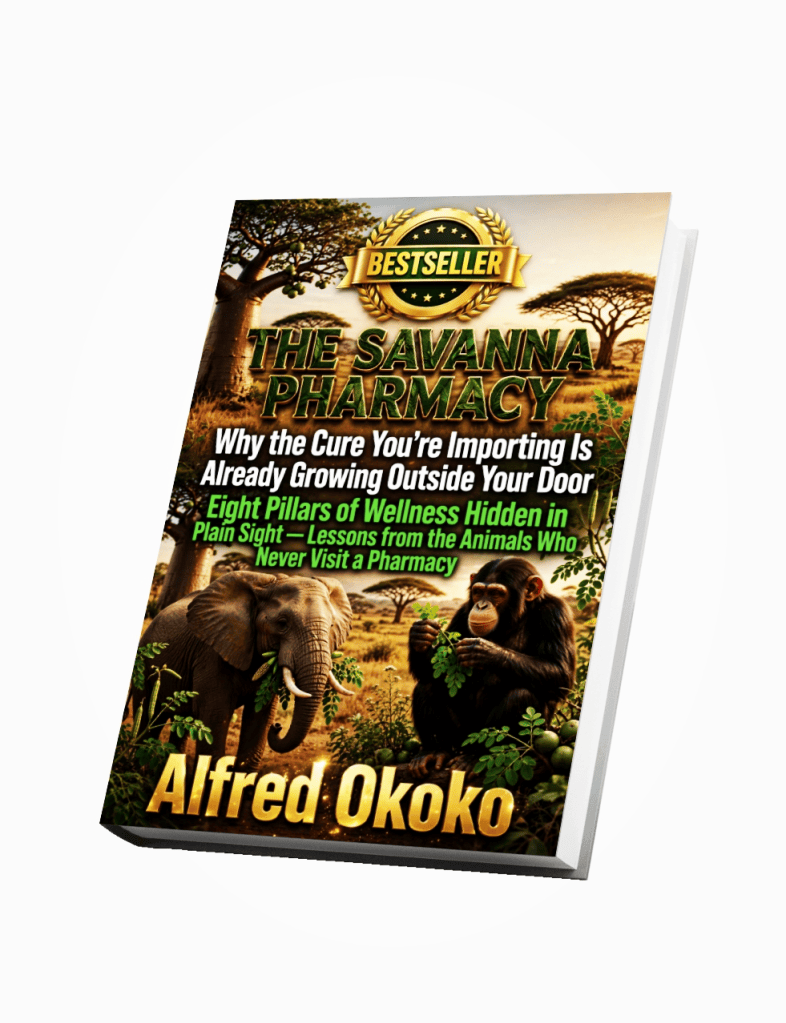
The Core Promise of This Book
By the final page, you will see your own environment — your shamba, your fence line, your market, your morning walk — as a complete, free, and scientifically credible wellness system, and you will have a practical, culturally grounded plan to stop paying for health you already own.
1. Stop Buying What You Already Have
You will understand, clearly and without shame, why you were convinced that imported equals better — and you will replace that conviction with a working knowledge of the remedies, foods, rhythms, and practices already present in your Kenyan environment, most of them free or nearly free.
2. Recover the Eight Pillars
You will learn to identify and activate all eight pillars of wellness — nourishment, movement, rest, water, herbal wisdom, community, mind and spirit, and purpose — as they exist specifically in the Kenyan landscape, not as abstract imports from foreign wellness culture.
3. Learn from the Animals
You will see the animals of the savanna — the impala, the giraffe, the elephant, the herd — as your teachers and your evidence: living proof that this environment sustains health without pharmacies, supplements, or lifestyle disease, when its own provisions are used.
4. Save Money and Redirect It
You will cut the household spend bleeding into imported supplements and reinvest it — in school fees, in savings, in your home garden — while improving, not sacrificing, your family’s wellness.
5. Act This Week, Not Someday
You will close the book with a concrete seven-day reset, a home pharmacy garden plan, a safety-first guide to herbal use, and a simple way to teach the next generation — so the knowledge becomes practice, and the practice becomes inheritance.
The One-Sentence Promise
This book will convince you that nature already filled your prescription — and then hand you the map to go and collect it.
What This Book Does Not Promise
It does not promise that every plant cures every ailment, or replace qualified medical care for serious conditions.· It does not romanticise poverty or pretend that all traditional knowledge is automatically safe — it insists on informed, responsible use.· It does not ask you to reject modern medicine — it asks you to stop neglecting the medicine that was placed here first. The promise is not a new discovery. It is a homecoming.
To obtain your FREE chapter one Pdf download ,comment the word SAVANNA via WhatsApp number 0726530868

